Wny workforce transformation is never just about the tech

Experience has taught me that the hard work lies in developing ‘soft skills’ in leadership and empathy, writes Wendy Edie

When I first started working in learning technology nearly three decades ago, we were just starting to deliver online courses over dial-up connections. Progress bars crept slowly across screens, and simply getting someone logged in felt like an achievement. Today, we’re talking about AI copilots, personalised learning journeys, and evidencing real-time skills development embedded into everyday work.

Technology has changed beyond recognition, but one thing has remained constant for me: successful workforce transformation has never been about the technology alone. In fact, I would say that is the easiest bit. The hard work lies in developing what can be considered ‘soft skills’ in leadership and, crucially, empathy.

That belief is shaped not only by my career but by my life as a mother. My two grown-up children have taken very different paths through education. One is thriving academically at university. The other, who told me after their first day at high school that “this isn’t for me”, has built a career through an apprenticeship in mechanics. Watching them learn in completely different ways has reinforced in me that there is no single route to capability, and technology must never assume there is.

Yet many organisations still fall into the same trap. One of the biggest misconceptions I see among business leaders is the idea that technology itself is the disruption. In reality, the real challenge is organisational mindset. Technology evolves rapidly, we’ve gone from dial-up learning platforms to AI copilots in the space of a generation, but leadership behaviour often changes far more slowly. Companies invest in new tools, while human behaviour means we continue to manage people and skills in outdated ways. As a result, transformation can stall before it begins.
Scotland’s learning technology sector reflects this rapid evolution. What started as a niche technical discipline has become a globally respected ecosystem, fuelled by some great collaboration between educators, businesses, and technologists.

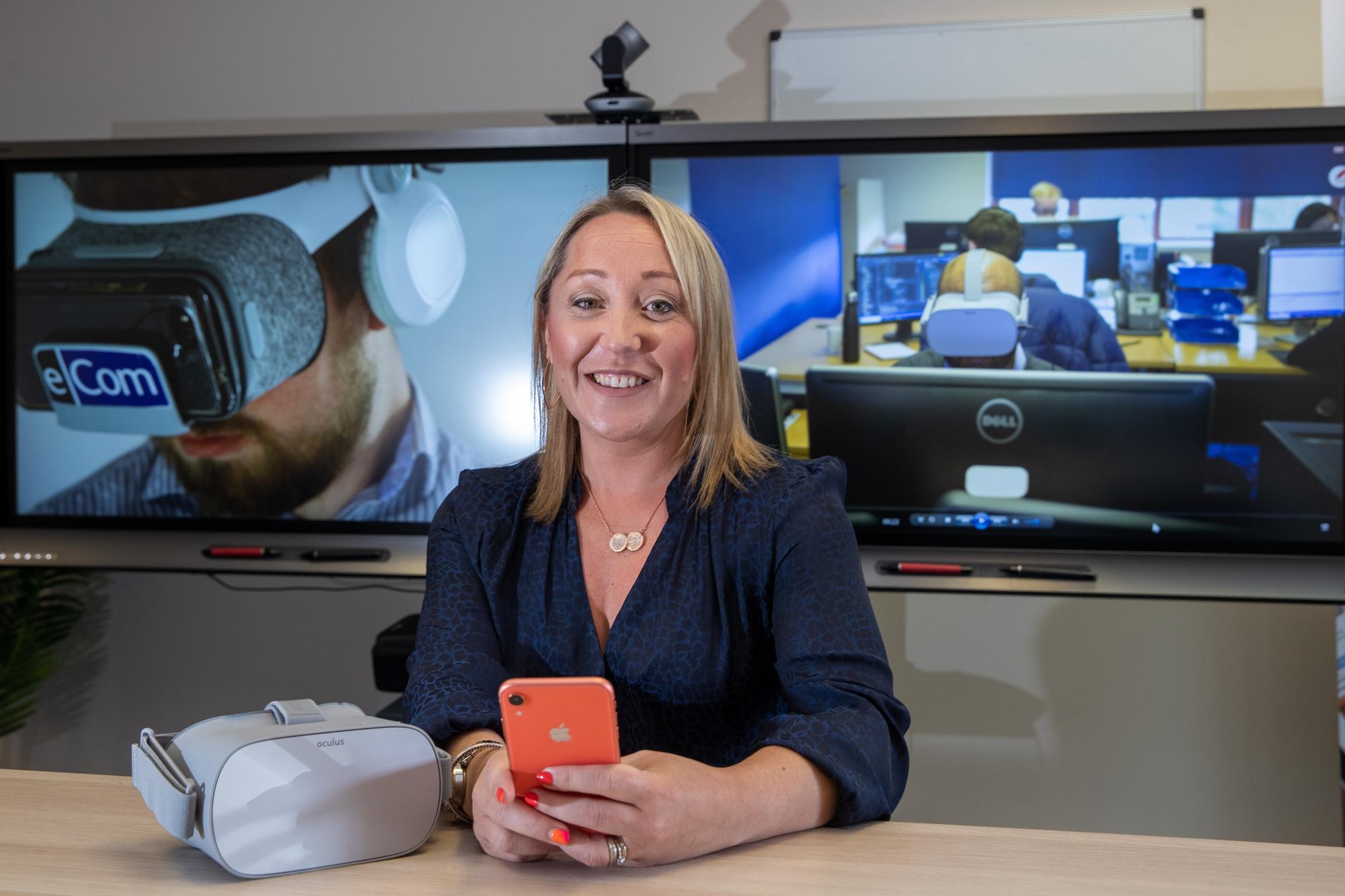
During eCom’s 30 years within innovation in learning technology, I’ve worked on amazing, impactful projects over the years, and now, working on global social change online learning and assessment solutions that are utilising technology the right way. But as artificial intelligence accelerates innovation even further, we need to work hard to keep the focus on the human experience rather than the pace of change.

This is why empathy has become central to how I lead and how I think about workforce development. Empathy-led technology doesn’t mean simpler technology; it means more thoughtful technology. To me, that means building programmes and platforms that adapt to people, whether they’re studying in a university lecture hall or learning new skills between jobs on a workshop floor. Technology should support learning wherever it happens: out in the field or at a desk, online or offline. In fact, one of the great ironies of modern innovation is that, as technology becomes more advanced, reliable offline access has become one of the most important requirements for real-world learning.

As we celebrate 30 years in this industry, I would say that one message is clear. Workforce transformation is not a one-off initiative or even a new platform rollout. It requires a culture where learning is continuous, accessible, and aligned with real work. The organisations that will succeed in the next decade will be those that remove barriers rather than add complexity, and treat empathy as a strategic advantage, not a soft skill.

The journey from those early dial-up courses to today’s AI-powered tools, the pace of innovation is extraordinary. But our real responsibility as leaders is to ensure that, as technology evolves, learning becomes more inclusive, more accessible, and more human – not less.

Wendy Edie, CEO, eCom Learning Solutions

From automated farm tractors to exam paper grading, AI boosts efficiency for some in India

Farmer Bir Virk tapped the iPad mounted beside his tractor’s steering wheel and switched the vehicle to automatic mode. The machine moved forward and began harvesting potatoes on its own in the fields of Karnal, a city in northern India.

Some 145 kilometers (90 miles) away in the country’s capital of New Delhi, educator Swetank Pandey employed similar automation at his coaching academy. He used algorithms to scan and grade handwritten exam papers from candidates for India’s competitive civil services.

In both cases, the same invisible hand was at work: artificial intelligence.

From farms to classrooms, AI is fast emerging as a tool for many Indians to boost efficiency and cut time, costs and labor. Early adopters, like Virk and Pandey, say the technology is helping them boost productivity as they test AI’s potential to find solutions at work.

“I am able to farm very efficiently and I feel very happy that I do the work what my grandfather and father used to do. Now I am carrying the tradition forward with the right technology,” said Virk.

India is testing its AI scale

As AI use surges across the globe, the technology is steadily gaining ground across India as businesses, startups and individuals experiment with new ways to improve efficiency.

The Indian government is also rolling out national initiatives to fund research and train workers in AI. That push is on display this week as New Delhi hosts a five-day AI summit, which is being attended by heads of state and top tech CEOs.

With nearly a billion internet users, India has also become a key focus for global tech companies to scale their AI businesses in one of the world’s fastest-growing digital markets.

Last December, Microsoft announced a $17.5 billion investment over four years to expand cloud and AI infrastructure in India. It followed Google’s $15 billion investment over five years, including plans for its first AI hub in the country.

“There’s some good use cases that have started. There are these scaling platforms that are now embedding AI into them,” said Sangeeta Gupta, senior vice president at NASSCOM, a prominent body representing India’s technology industry.

India’s adoption to AI, however, has its constraints.

The country still lags in developing its own large-scale AI model like U.S.-based OpenAI or China’s DeepSeek, highlighting challenges such as limited access to advanced semiconductor chips, data centers and hundreds of local languages to learn from.

While tech companies have ramped up spending on AI training and reskilling, those unable to adapt are being pushed out. Tata Consultancy Services, the country’s largest private employer, cut more than 12,000 jobs last year, driven by a rapid shift toward AI.

At the same time, however, people like Virk and Pandey say AI tools are already making their work faster and more efficient.

Precision agriculture through AI

Virk, the farmer, first encountered AI-driven farming technology five years ago while studying and working in the United States. When he returned to India in 2021, he imported the system from a Swedish company and has been using it on his farm for the past couple of years.

His automated tractor can plant seeds, spray fertilizer and harvest crops. The system costs about $3,864 and combines a steering motor, satellite signals that help move the tractor precisely, and an AI-driven software that converts data into movement.

It also logs errors and uploads them to a cloud platform, where the software company analyzes the data and sends related updates back to the machine.

“Technology and intelligence play a big role in this. The tractor works in a straight line. It maintains an accuracy of 0.01 centimeter (0.004 inch),” Virk said.

He said his AI-enabled tractor has reduced his work time by half.

“Its most special feature is that it is self-learning,” he said.

AI enters India’s famed exam factories

Educator Pandey teaches at a civil services coaching center, a sector known for its fierce competition. Millions of young Indians compete for civil service jobs each year, and coaching centers process vast numbers of tests, evaluations and revisions.

Pandey said AI has made that workload easier to manage.

Using large language models such as ChatGPT, Gemini and Claude, along with other automation tools, Pandey and his team scan and evaluate answer sheets, create targeted study material and structure syllabuses for the aspirants.

Pandey said the technology helps him carry out repetitive tasks, allowing tens of thousands of answer sheets to be evaluated in as little as 20 to 25 minutes.

“If you have a better machine, bigger system, you can do it in two minutes,” he said.

For now, his coaching academy uses a hybrid model. AI helps with evaluations and teachers review the output, improving both speed and quality.

Pandey said AI often produces study material that students find more relatable than those devised by teachers.

“AI is able to give us in advance a basic idea what the student is doing right now and what next he or she should do to be able to achieve their goals,” he said.

——

Saaliq reported from New Delhi.

From news to politics, travel to sport, culture to climate – The Independent has a host of free newsletters to suit your interests. To find the stories you want to read, and more, in your inbox, click here.

Microsoft confirms new Windows 11 feature drop coming next month

Microsoft has issued a new Windows 11 Release Preview build which gives us our first look at the next feature drop that the company is expected to begin rolling out in the next handful of weeks. This next wave of features is all about quality of life improvements, with Taskbar updates and new Emoji headlining the release.

Windows 11 receives new feature drops on a monthly cadence as part of Microsoft’s “Continuous Innovation” update strategy, which see’s new features ship when they’re ready instead of annually as part of a larger Windows version update.

This next wave of new features includes the new Emoji 16.0 release, which adds a handful of new emoji’s such as a fingerprint emoji, harp emoji, and shovel emoji. These new emoji’s will appear in the Emoji panel on Windows 11, which can be accessed with the Win+. keyboard combination.

Also new in this next feature drop are improvements to the Taskbar. Microsoft is adding a built-in network speed test shortcut to the Taskbar, which can be accessed by right-clicking the network icon in the system tray. This release also brings in-box Sysmon support, though the feature is disabled by default.

Here’s a complete rundown of the new features Microsoft is now testing with today’s Release Preview build, which are expected to begin rolling out to production PCs in the next few weeks:

  • [Emoji] New! The Emoji 16.0 release introduces a small thoughtfully curated set of new emojis, one from each major category. These new emojis now appear in the emoji panel.
  • [Backup & Restore] New! The first sign-in restore experience is now part of Windows Backup for Organizations, bringing this restore capability to more device types. This experience restores user settings and Microsoft Store apps automatically at first sign-in on Microsoft Entra hybrid joined devices, Cloud PCs, and multi‑user environments. This capability helps create a consistent setup process during device refreshes, upgrades, or migrations.
  • [Quick Machine Recovery] New! Quick Machine Recovery (QMR) now turns on automatically for Windows Professional devices that are not domain‑joined and not enrolled in enterprise endpoint management. These devices receive the same recovery features available to Windows Home users. For domain‑joined or enterprise managed devices, QMR stays off unless it is enabled by the organization.
  • [Taskbar & System Tray]
    • New! A built‑in network speed test is now available from the taskbar. Open it from the Wi‑Fi or Cellular Quick Settings, or by right-clicking the network icon in the system tray. The speed test opens in the default browser and measures Ethernet, Wi‑Fi, and Cellular connections. This feature helps check network performance and troubleshoot issues.
    • Improved: When your taskbar is set to uncombined, if you have an app open with many windows, they will no longer all move as a set to the overflow area when there is not enough space on the taskbar, and instead only the ones specifically within the set that don’t have space. With this change, the overflow area should no longer appear to display with lots of available space.
  • [Accounts] New! A new entry point in the account menu on the Start menu now directs you to the benefits page (https://account.microsoft.com/). This update makes it easier to explore and manage the benefits associated with your Microsoft account.
  • [Identity & Access Management] New! Windows now supports Microsoft Entra ID group and role SID resolution. This update enables Windows to translate Entra cloud group and role security identifiers (SIDs) to readable names, allowing Entra-only groups to be used and displayed correctly in file permissions, local group membership, and access control scenarios without relying on on‑premises or hybrid Active Directory identities.
  • [Camera SettingsNew! You can now control pan and tilt for supported cameras in the Settings app. The controls appear under Settings > Bluetooth & devices > Cameras, in the “Basic settings” section for your selected camera.
  • [Built-in Sysmon] NewWindows now brings Sysmon functionality natively to Windows. Sysmon functionality allows you to capture system events that can help with threat detection, and you can use custom configuration files to filter the events you want to monitor. The captured events are written on the Windows event log, enabling them to be used with security applications and a wide range of use cases.
  • Built-in Sysmon is disabled by default and must be explicitly enabled.
    • Go to Settings > System > Optional features > More Windows features > checking Sysmon or in PowerShell or command prompt:Dism /Online /Enable-Feature /FeatureName:Sysmon
    • To complete the installation, from PowerShell or command prompt run:sysmon -i
    • Note: If you’ve already installed Sysmon from the website, it must be uninstalled before enabling the built-in Sysmon.
  • [Widgets] New! Widget Settings now opens as a full‑page experience in the Widgets app instead of opening in a dialog.
  • [Desktop Background] New! You can now set .webp image files as your desktop background in Settings > Personalization > Background, as well as when right clicking the image in File Explorer.
  • [Search] Improved: Updated icon for the search process in Task Manager to now show a magnifying glass.
  • [Storage Settings]
    • ImprovedUpdated some of the dialogs in Storage Settings to have a more modern design.
    • Improved Performance of scanning for temporary files.
  • [Windows Update Settings] Improves the responsiveness of the settings page.
  • [Login and lock screens] Improves the login screen reliability.
  • [Nearby Sharing] Improves the reliability of sending larger files.
  • [Projecting] Improves the reliability of displaying the project pane after pressing the Windows key plus P.
  • [Printing] Improves the Windows print service (spoolsv.exe) to ensure smoother performance and prevent slowdowns during high‑volume printing.
  • [File Explorer]
    • Improved: Added the extract all option to the File Explorer command bar when browsing non-ZIP archive folders.
    • Fixed: Holding Shift and clicking the File Explorer in the taskbar, or middle clicking, might open the current instance of File Explorer rather than another instance.
    • Improved reliability of displaying devices on the Network page of File Explorer.
  • [Display]
  • Improved: Made display related performance improvements to help reduce PC resume-from-sleep time on heavily loaded systems and other scenarios.
  • Improved: For laptops used with a docking station while the lid is closed, improved reliability of resuming from sleep when connecting to AC power, without needing to open the laptop lid.
  • [Other] Addressed a few small visual issues, including when the taskbar was set to autohide, with the Windows Security pop up credentials fields, and with the print dialog.

All of these new features are now rolling out for Windows Insiders in the Release Preview Channel, and are expected to begin rolling out to everyone running Windows 11 in the next handful of weeks, starting with the non-preview security update for February which is expected to be released before the end of the month.

Join us on Reddit at r/Sohh.comto share your insights and discuss our latest news, reviews, and more.

Like this article? For more stories like this, follow us on MSN by clicking the +Follow button at the top of this page.

I love electronic music – but AI artists are missing the one thing that makes songs matter

Stop me if you’ve heard this before: musicians are urging people not to embrace new technology because it’s not real music and it’ll put real musicians out of work. This time the year is 2026 and the technology is AI, but it’s a song we’ve heard before. I remember hearing it back in 1982, when members of the UK Musicians’ Union wanted to ban synthesizers and drum machines to protect working musicians’ jobs.

There’s a long tradition of musicians going “nooooooo!” about new technology in music. In the 1960s there were calls to ban the Mellotron, fearing it would replace session string players. In the 1970s and 1980s disco and dance music’s use of synths and drum machines was derided. In the late 1990s and early 2000s Autotune was the enemy. And now many people are arguing against the use of generative AI.

AI boosters argue that this is history repeating, a reactionary backlash to new musical tools. But generative AI is very different from the tech that came before it.

Talkin’ ’bout AI generation

Whether it’s a synth, a sampler, Autotune or Ableton Live, tech can do great things in music. And you can say the same about AI. Many artists use AI-based mastering tools to make their songs sound better, and tools like AI stem separation and chord detection are incredible. But they’re musical helpers, not music creators.

Fans of generative AI say that artists will use the tech as they did drum machines and digital audio workstations, using new tools to reach new creative heights. And I’m sure many artists will: platforms such as Mozart.ai, which bill themselves as musical co-producers rather than music generators, which create parts of songs rather than complete tracks and which promise that their system wasn’t trained on stolen sounds, look very promising. But what worries me is that the music those musicians make won’t be heard, and won’t make them any money.

And that’s because right now generative AI isn’t really being used to help musicians. It’s being used to drown them out.

Slop, slop, slop music

Streaming services are experiencing a plague of AI slop: waves of AI-generated songs designed to sound like popular artists and in some cases, actually pretending to be real artists. They’re not so much songs as spam, and they can be generated in massive quantities with virtually zero effort. Slop can be created and uploaded far faster than any system can detect it and take it down, leading to the AI grey goo scenario where the volume of AI-generated content overwhelms everything.

That’s a problem for artists because every space on a playlist or page taken up by AI slop is a space a human artist doesn’t get to fill. So the more AI there is the harder it becomes for humans to stand out, and the harder it becomes for them make any money from their music. If they’re not being played in big enough numbers, they’re not being paid.

Recording musicians make money from copyright: they (or their record company) own the rights to their music, and if you want to play it, broadcast it or stream it you need to pay the copyright owner for the right to do that. Spotify alone paid over $11 billion to rights owners in 2025.

Generative AI threatens artists’ income in two ways. First of all, it’s largely based on stealing music from artists: Suno, the leading generative AI music platform, admits that it was trained on “essentially all music files on internet” and like other AI firms it argues that grabbing all that music for training data shouldn’t require permission or payment.

Secondly, as the law currently stands in the US and elsewhere you can’t copyright fully AI-generated music because it isn’t made by any humans; writing prompts isn’t currently considered the same as writing a melody or a lyric.

If you take those two things together (and if the AI firms’ arguments aren’t thrown out of court) you have a real nightmare for musicians: generative AI can take your music without paying for it, make music based on it, and then charge people to use or listen to that music without giving you a cent. All the money that would normally have gone to the music business and to artists goes to the platform owner instead.

Generative AI is offering platforms a magic musical money tree. Let’s say you’re a streamer who brings in around $16 billion a year in revenues and spends $11 billion on paying copyright owners for the rights to stream their songs. How sweet does fully AI-generated music sound right now?

And it’s not just streamers. Music soundtracks all kinds of things from blockbuster movies to YouTube ads. It’s played in stores, in waiting rooms, in receptions and in offices and on factory floors. All of these things pay human musicians. But for how much longer?

The song remains the same

That has the potential to affect all of us, musicians and music fans alike. If your favorite streaming service gets stuffed with AI slop and packs its playlists with AI performances, that’s going to make it so much harder for you to find great music by human artists.

Does that matter? I think it does.

I’m no “keep music real” reactionary who thinks music should only be played on bits of wood by people with beards; I’ve just published a book celebrating music including Hi-NRG, Chicago house, electronic pop and hyperpop. As a musician, I think simulations such as Breaking Rust and Xania Monet, and the music Suno can make in seconds, are technologically very impressive. But as a music fan their music leaves me completely cold.

The tech may be new but what they’re doing is very old: whenever there’s a genuinely good artist there will be imitators trying to copy them. Very few copycats turn out to be anywhere near as good as the people they’re copying.

And that’s the case with the fully AI artists I’ve heard so far. It’s music that’s been made to sound like other people’s music, and that means it’s been made without the passion and soul and personality that makes good music so great and that makes music matter so much to so many of us.

I have another worry, which is that humans will start copying AI music — because if that’s what the platforms prioritise, if that’s what social media rewards, then plenty of musicians will try to jump on the bandwagon because the algorithms will bury anything else.

That’s a future I’d hate to hear, a future where music becomes muzak and pop becomes slop.

Follow Sohh.comon Google News and add us as a preferred source to get our expert news, reviews, and opinion in your feeds. Make sure to click the Follow button!

And of course you can also follow Sohh.comon TikTok for news, reviews, unboxings in video form, and get regular updates from us on WhatsApp too.

Like this article? For more stories like this, follow us on MSN by clicking the +Follow button at the top of this page.

Mark Cuban challenges grim predictions claiming software jobs wipeout due to AI

In the midst of mounting panic over artificial intelligence, billionaire Mark Cuban has delivered a blunt rebuttal to claims that a software job wipeout is inevitable. The debate over AI and employment has intensified in recent months, with industry leaders and analysts warning that automation could erase millions of roles. Software engineers, long seen as beneficiaries of technological change, now find themselves at the centre of the storm.

Yet Cuban, the outspoken entrepreneur and former Shark Tank investor, is pushing back hard against the narrative that AI will decimate software jobs. Speaking in response to reports that artificial intelligence could replace programmers at scale, he questioned the logic behind such sweeping forecasts. Cuban challenged those predicting a software job wipeout by pointing to the sheer scale of the technology industry in the United States.

Who Will Build The Future?

Cuban’s central argument is disarmingly simple. If AI truly wipes away software jobs, who will build and manage the vast ecosystem of technology companies that depend on human expertise? He reportedly highlighted that there are roughly 33 million technology-related companies in the US. ‘If AI wipes away software jobs, who will work at the 33 million technology companies in the US?’ he asked, casting doubt on the sweeping assumptions driving the narrative.

For Cuban, the idea that AI will entirely replace programmers ignores how businesses actually operate. Technology evolves, but it also creates new layers of demand.

AI as a Tool, Not a Replacement

Cuban has long positioned himself as a pragmatic observer of innovation. Rather than viewing AI as a job destroyer, he frames it as a tool that amplifies human capability. In his view, AI will transform how developers work, not eliminate them. Routine coding tasks may be automated, but higher-level thinking, system design, and problem-solving will remain deeply human responsibilities.

He has previously argued that technological shifts often spark fears that fail to materialise at the scale predicted. The same anxieties surfaced during the rise of the internet and cloud computing. Yet, instead of mass job losses, those innovations produced new roles and entirely new sectors.

Challenging the Fear Narrative

The intensity of current warnings about AI has unsettled many young professionals considering careers in programming. Social media platforms are filled with posts suggesting that coding may soon be obsolete. Cuban’s challenge cuts directly into this climate of uncertainty. By questioning who will staff millions of tech firms if programmers vanish, he reframes the conversation.

He does not deny that AI will disrupt certain roles. Instead, he disputes the apocalyptic tone that suggests a total collapse of software employment.

Economic Reality Versus Tech Hype

Predictions of widespread job losses often rely on rapid improvements in generative AI tools. These systems can now produce code snippets, debug errors, and even build simple applications. However, Cuban appears sceptical that such tools can replace the nuanced judgement required in complex enterprise environments.

Businesses depend on collaboration, oversight, security, and accountability. AI may assist in coding, but it cannot assume legal responsibility or strategic decision-making. Cuban’s stance reflects a broader belief that markets adjust. As AI increases productivity, demand for tech-enabled solutions could rise, creating fresh opportunities rather than eliminating them.

A Message to Aspiring Developers

For students and early-career engineers, Cuban’s comments offer a measure of reassurance. The spectre of mass automation has led some to question whether investing years in learning to code is worthwhile. Cuban’s challenge suggests the opposite. Mastery of AI tools, combined with core programming skills, could make developers more valuable, not less. The emphasis shifts from fearing AI to leveraging it.

The Debate Is Far From Over

The Debate Is Far From Over

The conversation about AI and employment is unlikely to fade. Economists, executives and technologists continue to clash over how deep the impact will be. Still, Cuban has injected a dose of realism into a debate often dominated by extremes.

By challenging the assumption of widespread job losses, he reminds observers that innovation historically reshapes work rather than erasing it entirely. As AI continues its rapid ascent, the future of software jobs may hinge less on replacement and more on reinvention.

Related Articles

・Elon Musk And Bill Gates Are Wrong About AI: LinkedIn Exec Reveals Data

・Anthropic Boss Warns: AI Could Obliterate 50% Of White-Collar Starter Roles

・’Godfather of AI’ Says AI Can’t Replicate Certain Jobs–Is Yours Part of the List?

・Anthropic CEO Warns AI Could Wipe Out Half of Entry-Level White-Collar Roles — Is Your Job in Trouble?