India AI summit descends into chaos amid long queues and Modi lockdown

India’s flagship artificial intelligence summit was overshadowed by chaos on its opening day amid long queues in unseasonal heat, traffic congestions, and sudden security sweeps ahead of prime minister Narendra Modi’s visit.

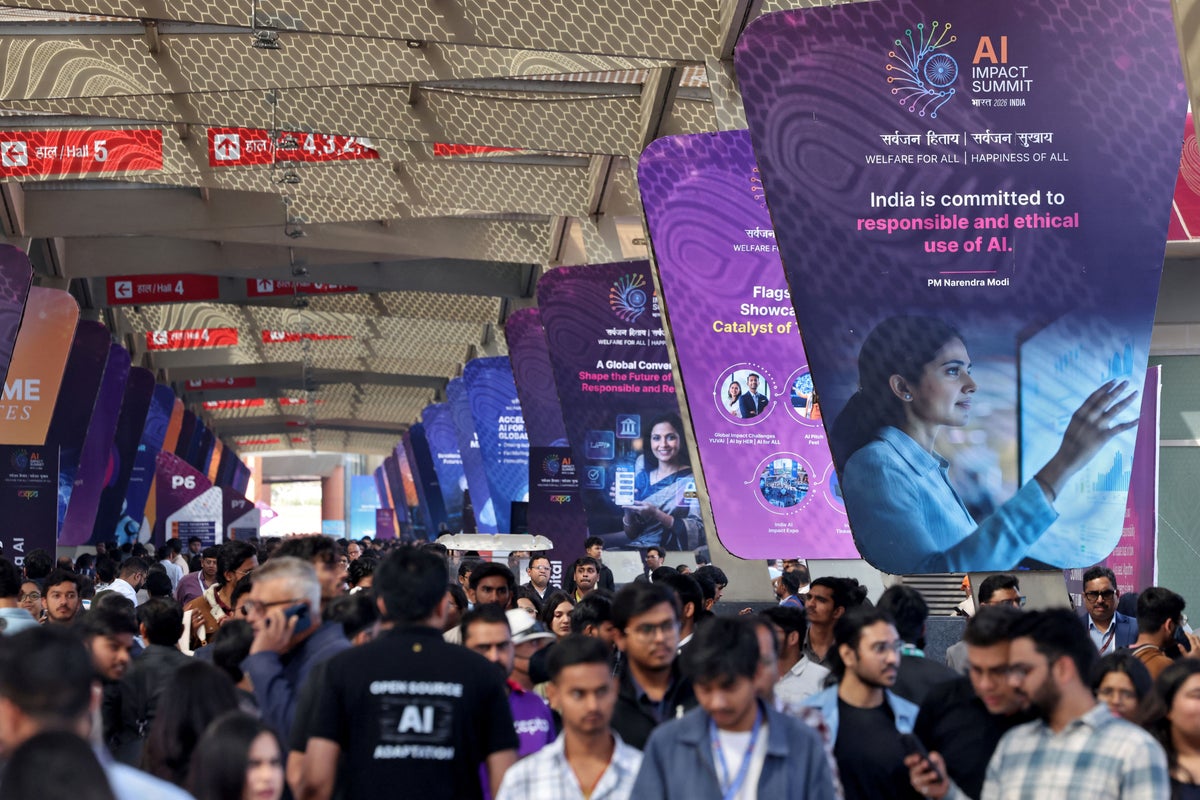
Thousands of people on Monday attended the summit at the 123-acre Bharat Mandapam complex in the capital Delhi. Over 250,000 had registered their attendance over the week. High profile guests included French president Emmanuel Macron and tech giants Sam Altman and Sundar Pichai as India aims to position itself as a global AI hub.

But for many on the ground, the first day was defined less by grand geopolitical messaging and more by blocked gates, delayed panels, and uncertainty over access.

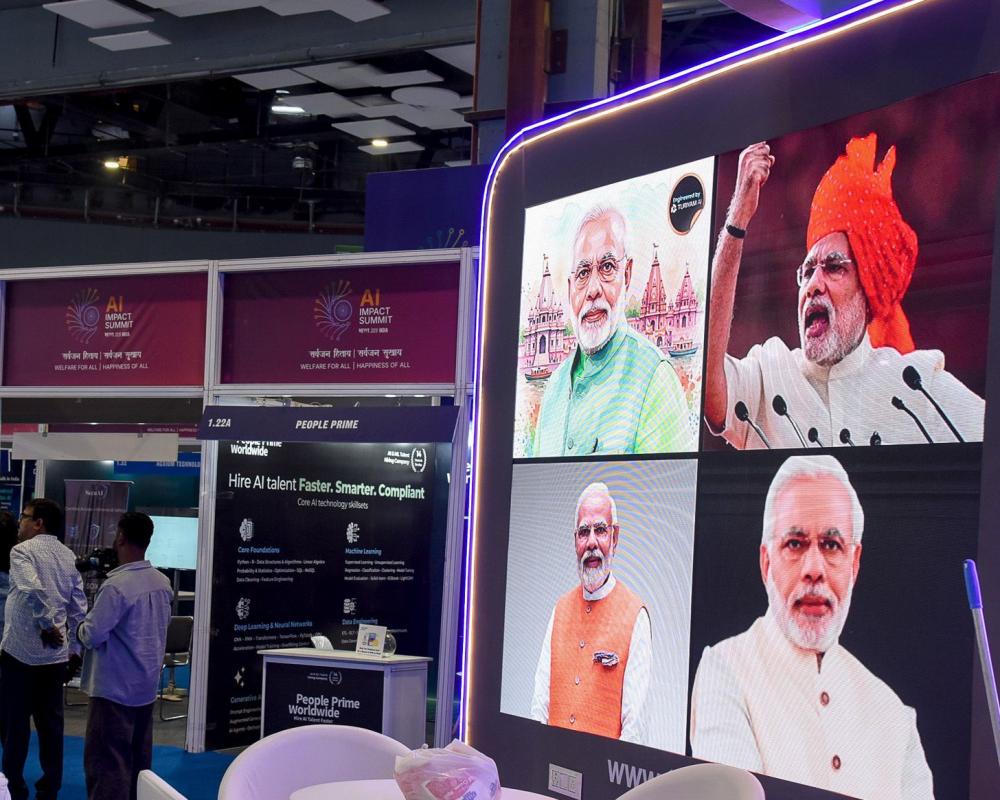
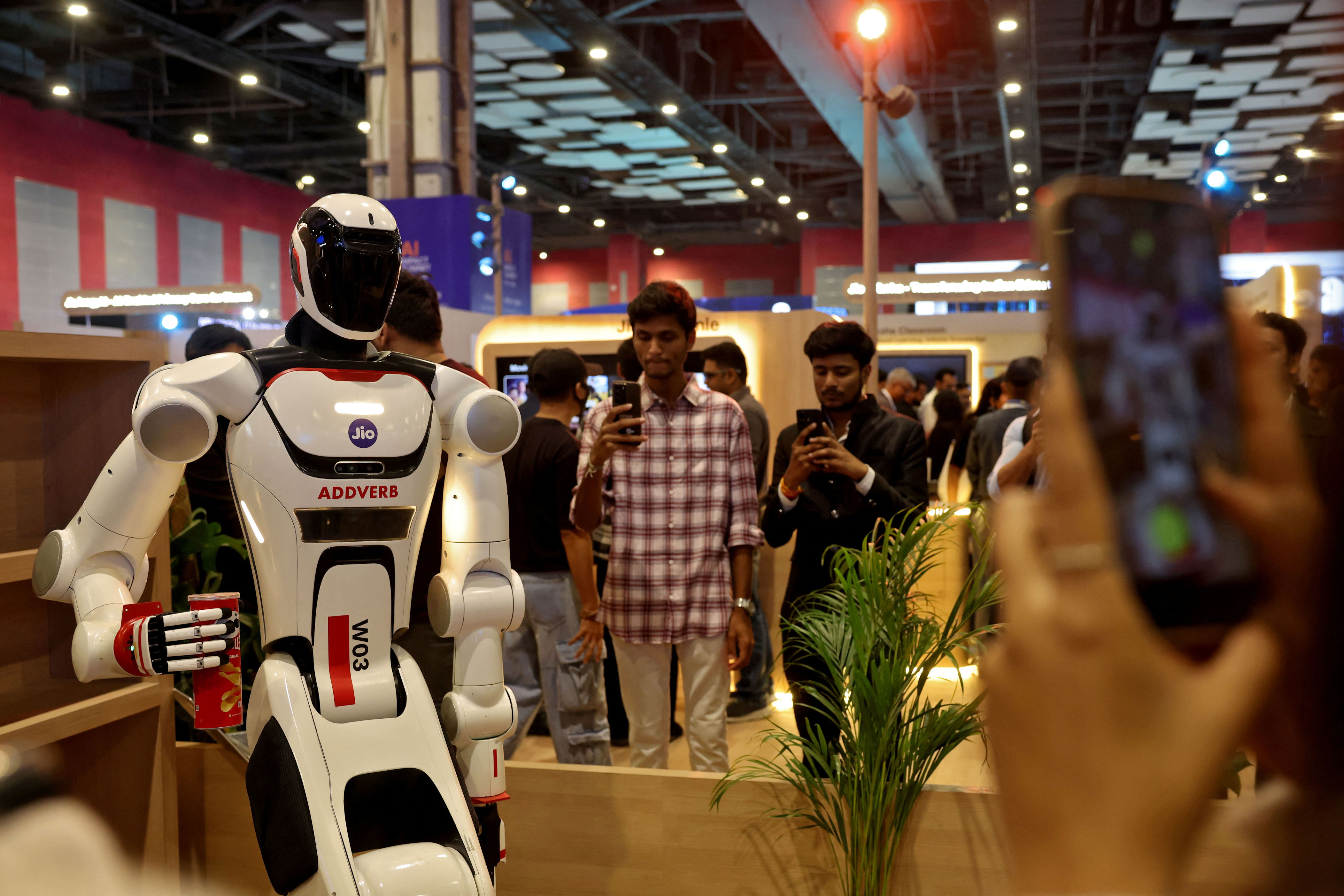
After allowing attendees inside the venue, including the main hall where the exhibitions were set up by companies showcasing their AI capabilities, the zone was evacuated in the afternoon for security checks ahead of Mr Modi’s visit, forcing exhibitors and founders to leave their stalls for several hours.

Founders posted online about being unable to retrieve their equipment which they later said were stolen after the sudden evacuation.

Dhananjay Yadav, co-founder and chief executive of AI wearable startup NeoSapien, wrote on X that security personnel arrived around noon and asked exhibitors to leave ahead of the prime minister’s visit.

“I asked: ‘Should we take our wearables?’ They said, others are leaving even laptops behind, security will take care,” he wrote.

“Later we found our wearables were stolen,” he said.

He added: “We paid for flights, accommodation, logistics and even the booth. Only to see our wearables disappear inside a high-security zone.”

Devesh Mahla, deputy commissioner of police, New Delhi district, told The Indian Express on Tuesday that they had not received any complaint in the matter so far.

Some exhibitors at the venue complained to organisers about unclear instructions and overlapping security directions, while some were unsure when access would be restored.

Delegates also described confusion over entry procedures and security checks, Reuters reported.

Sharing a photo of long queues outside the venue on X, Maitreya Wagh, founder of Bengaluru-based AI company Bolna, wrote: “Gates are closed so could not access my own booth at the AI Summit.

“If you’re also stuck outside and wanted to visit the @bolna_dev team, dm me. We may set up a mini-booth at some Connaught Place cafe,” he joked.

Several roads have been blocked and traffic was getting diverted in central Delhi ahead of the summit.

Organisers told Indian media on Tuesday that steps had been taken to ease congestion and improve coordination for the remaining days of the summit. By Tuesday morning, queues had eased slightly, though traffic diversions around central Delhi continued to affect arrival times for delegates and media.

“This is the biggest AI summit in the world. The response was phenomenal. The energy is palpable. We can see the organization is very smooth now. If anybody has faced any problems yesterday, we apologise for that,” India’s Information Technology minister Ashwini Vaishnaw said.

“Whatever feedback you have, please share with us. We are open-minded. We will make efforts to make the experience smoother and enjoyable for all of you. We have a war room which has been operating since yesterday. My entire team is working hard day and night for this summit,” he said.
The confusion extended into day two when Mr Gates’s name briefly disappeared from a list of speakers on the summit website, triggering speculation that he had been disinvited due to recent criticism over his association with Jeffrey Epstein.

One Indian media report cited government sources as saying Mr Gates was “not expected” to attend and that his invitation had been “reviewed”.

But a spokesperson for Mr Gates said the reports were not accurate, telling The Independent: “Bill Gates is attending the AI Impact Summit. He will be delivering his keynote as scheduled.”

Mr Gates’s invitation had earlier drawn criticism in India, with his visit attracting protests in the southern state of Andhra Pradesh by opposition political party members.

He arrived in India on Monday and met Andhra Pradesh chief minister N Chandrababu Naidu in Amaravati where he praised the state’s use of AI and technology in health, agriculture and education. He has been reviewing projects backed by the Gates Foundation, which is active in public health initiatives in the state.

The summit will continue till 20 February, with keynote addresses and high-level sessions scheduled on Thursday and Friday.

From news to politics, travel to sport, culture to climate – The Independent has a host of free newsletters to suit your interests. To find the stories you want to read, and more, in your inbox, click here.
NYT Connections #983: Hints and solutions for February 18, 2026

The Wednesday edition of NYT Connections arrives with puzzle #983, serving up a grid that rewards retro culture knowledge and agricultural terminology. Today’s challenge particularly favors those who remember 80s slang and can spot sneaky poultry descriptors.

What Makes Connections Tick

For newcomers, NYT Connections presents 16 words that must be sorted into four thematic groups of four.

The twist?

You’re limited to four mistakes, and the color-coded difficulty system (yellow being easiest, purple being trickiest) means surface-level connections often mislead.

Since its June 2023 launch, Connections has carved out its niche in the Times’ puzzle ecosystem, standing alongside Wordle and the crossword as a daily ritual for millions of players worldwide.

The game’s genius lies in its red herrings, words that could fit multiple categories but belong in only one.

Today’s Grid at a Glance

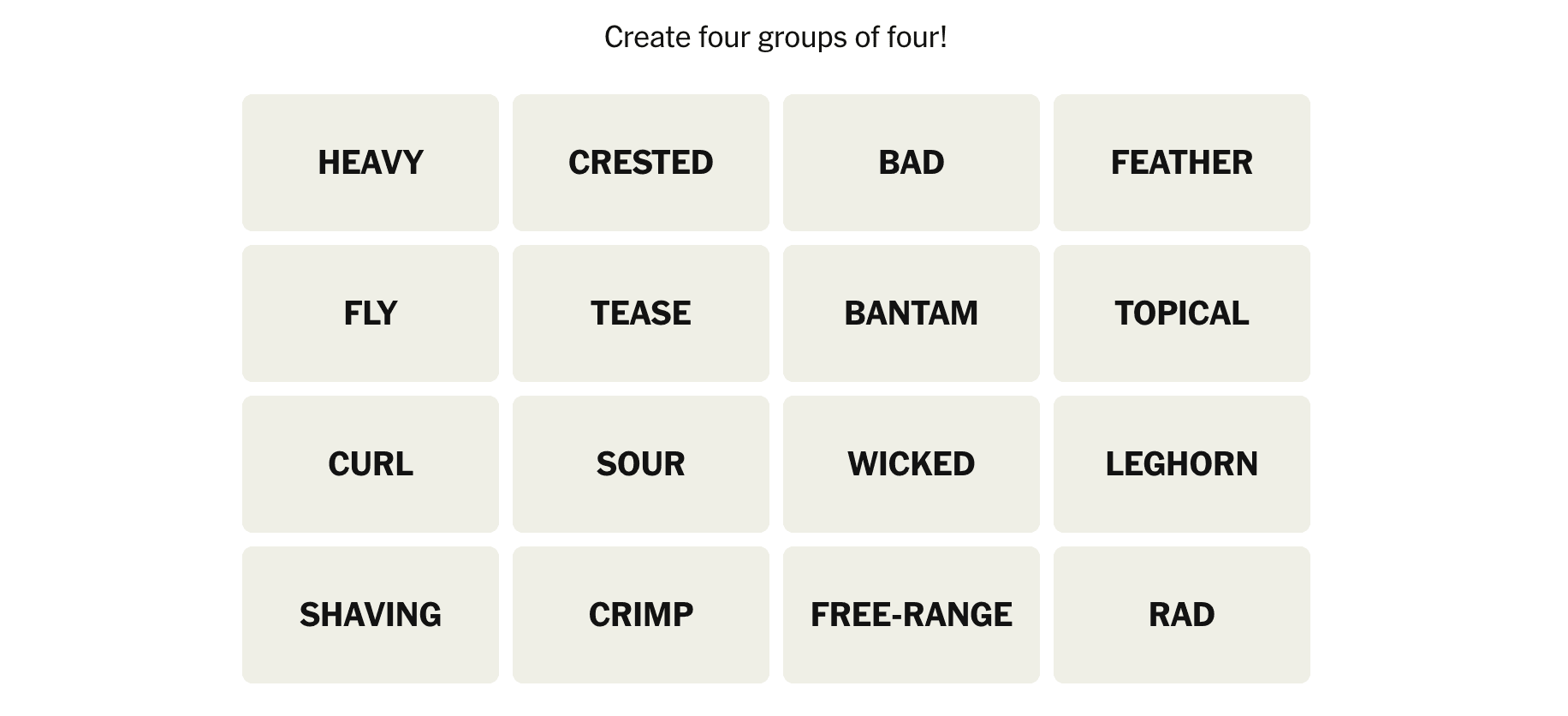
Here are the 16 words staring back at you in puzzle #983:

HEAVY | CRESTED | BAD | FEATHER

FLY | TEASE | BANTAM | TOPICAL

CURL | SOUR | WICKED | LEGHORN

SHAVING | CRIMP | FREE-RANGE | RAD

A seemingly random collection that somehow connects into four perfect categories.

Strategic Hints (No Spoilers Yet)

Yellow Category Nudge: Think about hairstyles that were popular in the 80s and 90s.

Green Category Clue: These words all meant “cool” or “excellent” in different decades.

Blue Category Hint: These terms describe different types or characteristics of chickens.

Purple Category Teaser: Each of these words can precede “cream” to form a common phrase.

The Full Solutions

Last chance to solve independently: answers below

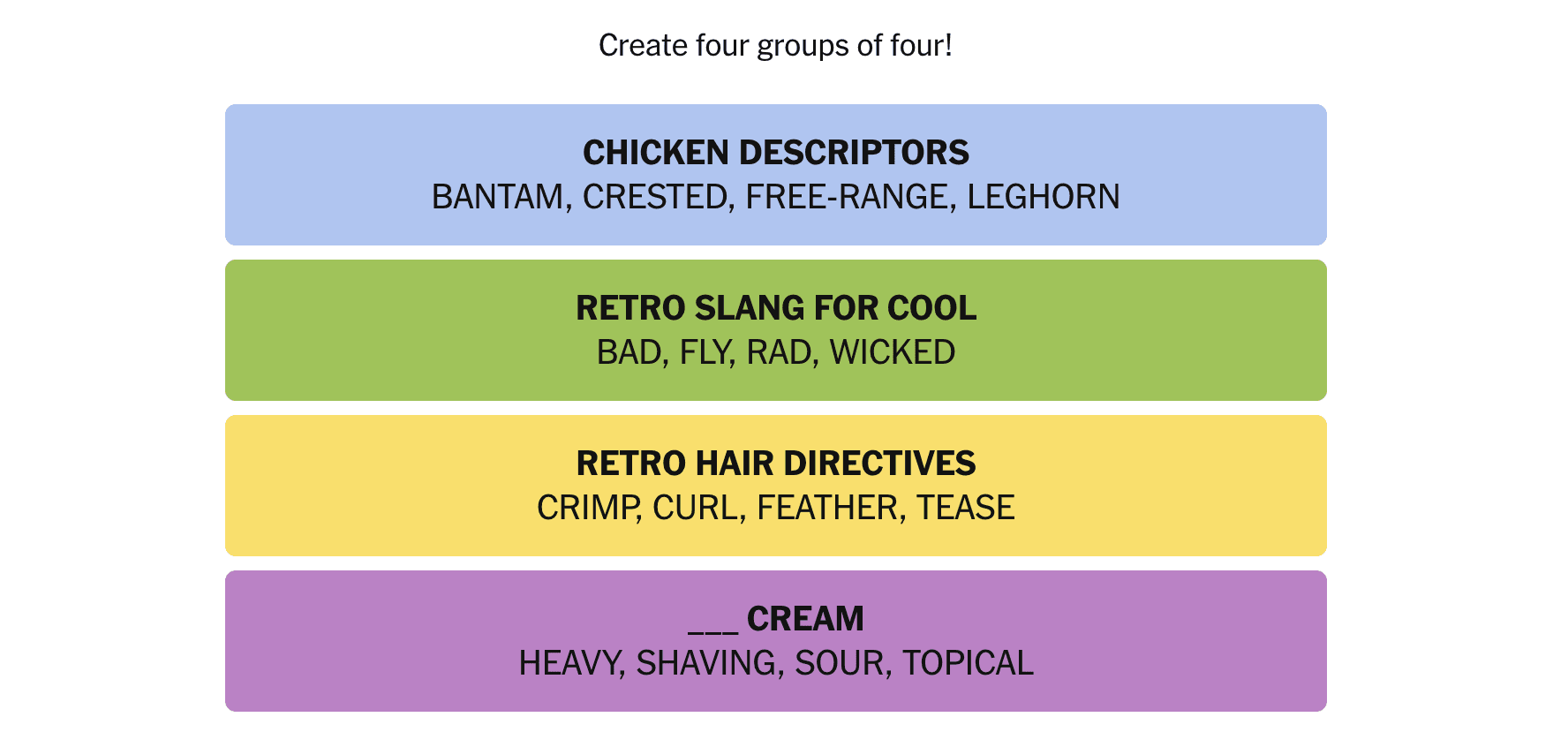
Yellow (Retro Hair Directives): CRIMP, CURL, FEATHER, TEASE

These four words all refer to specific hair styling techniques that were particularly popular in the 70s and 80s.

Crimping creates zigzag waves, curling adds spiral texture, feathering involves layered cutting, and teasing (or backcombing) adds volume at the roots.

Green (Retro Slang for Cool): BAD, FLY, RAD, WICKED

This category collects slang terms that all meant “cool” or “excellent” across different decades and subcultures.

“Bad” ironically meant good in 70s funk culture, “fly” emerged from 80s hip-hop, “rad” was quintessential 80s skate/surf slang, and “wicked” served as New England’s positive intensifier.

Blue (Chicken Descriptors): BANTAM, CRESTED, FREE-RANGE, LEGHORN

These terms all describe specific types or characteristics of chickens.

Bantam refers to small chicken breeds, crested describes breeds with distinctive head feathers, free-range indicates chickens with outdoor access, and Leghorn is a specific breed known for egg production.

Purple (___ Cream): HEAVY, SHAVING, SOUR, TOPICAL

Each of these words can precede “cream” to form common phrases.

Heavy cream is a dairy product, shaving cream is for grooming, sour cream is a condiment, and topical cream refers to medicinal ointments applied to the skin.

The Verdict

Puzzle #983 registers as moderate difficulty with a clever thematic split.

Yellow falls quickly for anyone who remembers 80s hairstyles, while green requires thinking about slang evolution across decades.

Blue separates the agricultural enthusiasts from the casual observers.

Purple, predictably, is the streak-ender, the “cream” connection won’t reveal itself without serious lateral thinking about common two-word phrases.

The real trap lies in words like “HEAVY” and “WICKED,” which could easily mislead solvers into thinking about weight or morality rather than their specific category roles.

“CRESTED” might initially suggest birds in general rather than specifically chicken breeds, while “TOPICAL” could distract with its multiple meanings.

Reset and Repeat

Tomorrow’s puzzle drops at midnight in your timezone.

Until then, reflect on today’s performance: did the retro hair terms come naturally, or did the chicken descriptors stump you?

The beauty lies not in perfection but in training your brain to spot these hidden patterns.

For now, puzzle #983 is solved.

See you at midnight for round #984.

NYT Connections #983: Hints and Solutions for February 18, 2026 – Originally published on Sohh.com

Tech billionaires fly in for Delhi AI expo as Modi jostles to lead in south

Silicon Valley tech billionaires will land in Delhi this week for an AI summit hosted by India’s prime minister, Narendra Modi, where leaders of the global south will wrestle for control over the fast-developing technology.

During the week-long AI Impact Summit, attended by thousands of tech executives, government officials and AI safety experts, tech companies valued at trillions of dollars will rub along with leaders of countries such as Kenya and Indonesia, where average wages dip well below $1,000 a month.

Amid a push to speed up AI adoption across the globe, Sundar Pichai, Sam Altman and Dario Amodei, the heads of Google, OpenAI and Anthropic, will all be there. Rishi Sunak and George Osborne, a former British prime minister and a former chancellor, will each be pushing for greater adoption of AI. Sunak has taken jobs for Microsoft and Anthropic and Osborne leads OpenAI’s push to deepen and widen the use of ChatGPT beyond its existing 800 million users.

Meanwhile Modi, who will address the summit on Thursday, is positioning India as the AI hub for south Asia and Africa. On the agenda will be AI’s potential to transform agriculture, water supplies and public health. Governments in Kenya, Senegal, Mauritius, Togo, Indonesia and Egypt will send ministers.

Modi’s enthusiasm for AI has a darker side, civil liberties campaigners say. Last week they raised serious concerns about India deploying AI to increase state surveillance, discriminate against minorities and sway elections. But Modi this week spoke of “harnessing artificial intelligence for human-centric progress” and India has given the summit the strapline: “Welfare for all, happiness for all.”

Summit observers talk of a battle between a new kind of AI colonialism from the US tech firms and an alternative “techno-Gandhism”, in which AI is used for social justice and to benefit marginalised people. After global AI summits in the UK, Korea and France, the Delhi meeting is the first to be held in the global south.

Indian commentators say the test of AI’s value is not in its technical sophistication but whether it can improve the lives of people living in some of the toughest circumstances in the global south. By contrast, US AI companies are racing for supremacy, competing with each other and China, and rolling out AI for shopping, personal companionship and agentic systems that could slash corporate labour costs by making white-collar jobs redundant.

If a referee between the two sides is needed, António Guterres, the secretary general of the United Nations, will speak in Delhi. This week he said it would be “totally unacceptable that AI would be just a privilege of the most developed countries or a division only between two superpowers”.

India’s AI Impact Summit is the fourth iteration of the event, which Sunak launched in 2023 at Bletchley Park in the UK, with a focus on international coordination to prevent catastrophic risks from the most advanced AI models. Summits followed in Seoul in 2024 and Paris in 2025, where the US vice-president, JD Vance, appeared to abandon the White House’s interest in safety saying: “The AI future will not be won by hand-wringing about safety; it will be won by building.”

Safety is once again on the agenda, with Yoshua Bengio, one of the “godfathers” of AI, on hand to repeat his fears about the risk of powerful AI systems enabling cyber- and bioweapons attacks.

“The capabilities of AI have continued to advance, and although mitigation and risk management of AI has also progressed [it has happened] not as quickly,” he said on Tuesday. “So it becomes urgent that leaders of this world understand where we could be going and it needs their attention and intervention as soon as possible.”

One of those working at the summit to make sure AI remains safe will be Nicolas Miaihle, co-founder of the AI Safety Connect group, who noted that the summit was taking place in the shadow of AI-enabled warfare in Ukraine and the Middle East.

“The existential risks are not going anywhere,” he told the Guardian. “When Rishi Sunak started this, the race was not raging as hard. The trillions are pouring in but we are very far away from securing these models. This is profound for democracy, profound for the mental health of our kids and profound for warfare.”

But the Trump administration continues its policy of refusing to bind US AI companies with red tape. The White House is not expected to send a high-level representative to Delhi, with Sriram Krishnan, its senior AI policy adviser, the highest-ranked speaker listed in the programme.

“Given where we are with the US administration it’s pretty unlikely you’re going to have a massive breakthrough on any consensus on what a regulatory framework will look like,” said one senior AI company source.

Companies such as Google are focused on the use of AI in education in India, where large language models’ ability to function in many of the country’s dozens of languages is an advantage.

“[There’s] a big focus on access and adoption, how can you make sure that the technology is available as broadly as possible,” said Owen Larter, head of frontier AI policy and public affairs at Google DeepMind. “We’re excited on the education front in India. It’s a remarkable story of an incredibly intense adoption. About 90% of teachers and students already using AI in their learning. We’ve had a big promotional programme where 2 million students have access to our pro subscription for free.”

Google’s investments in India include a $15bn spend, in partnership with the conglomerate of Gautam Adani, one of India’s richest billionaires, on an gigawatt-scale AI datacentre hub in the coastal city of Visakhapatnam, in Andhra Pradesh, with subsea cables connecting to other parts of the world.

This budget-friendly flagship puts a retro gaming screen on your phone’s back

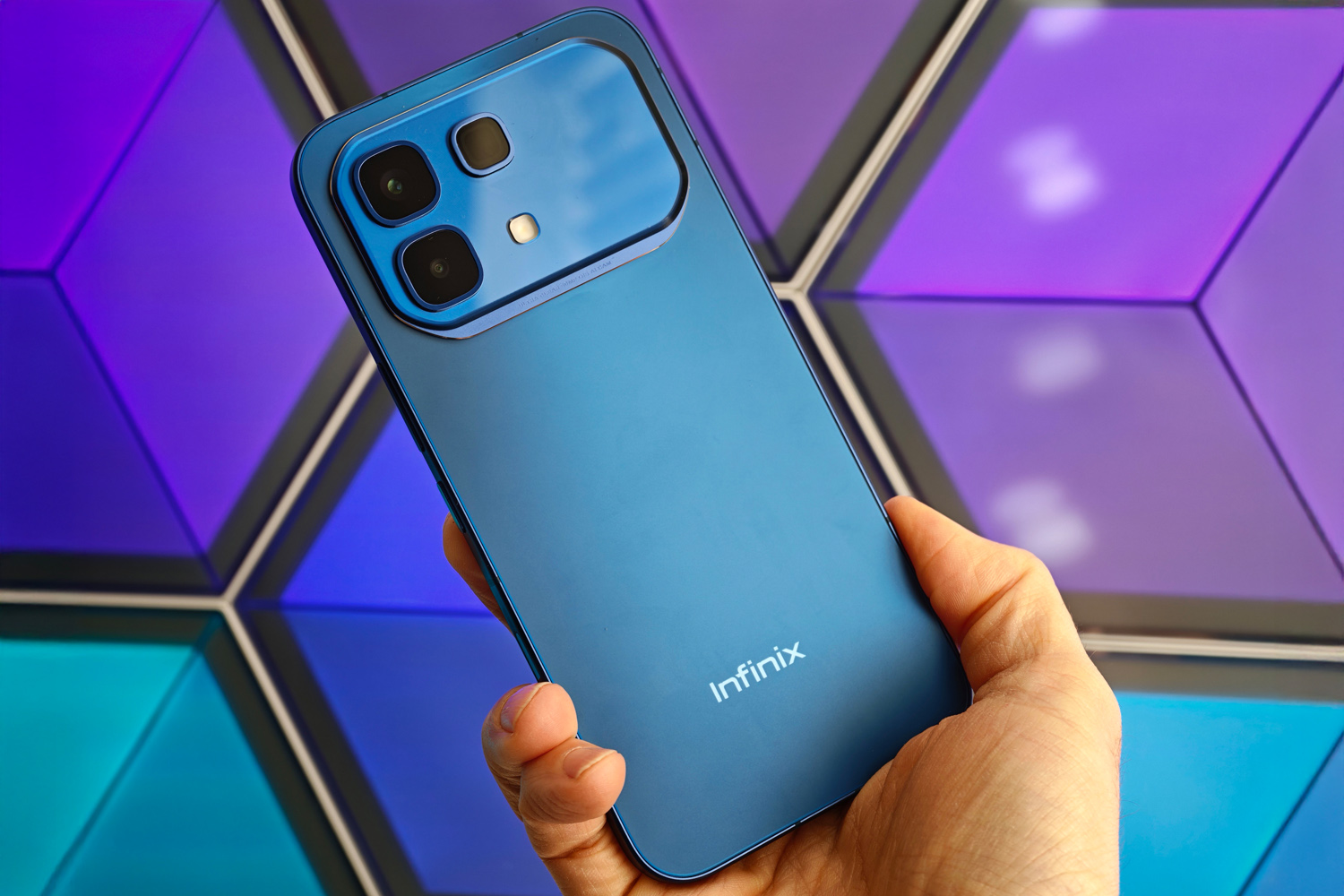
As we edge ever closer to the smartphone singularity, it’s nice to see at least one brand remembering to make handsets that are fun as well as functional. Infinix has given its latest sensibly-priced mid-ranger an active Matrix LED display, turning its Apple-aping rear camera island into a retro-style games machine that can also give you a heads-up on incoming notifications.

The Note 60 Pro is also the firm’s first in a long while with Snapdragon silicon, signalling a step out of true bargain territory and more into the mainstream. A sizeable battery and speedy charging add to the appeal.

I’ve been trying one out ahead of the launch. While a full review will have to wait until I’ve had more time for testing, first impressions are mostly positive – making me wish Infinix had a larger presence outside of its African and Indian heartland.

With a metal frame, rounded corners and a flat AMOLED display with satisfyingly skinny bezels, the Note 60 Pro punches above its weight in the looks department. It’s slender at a mere 7.45mm, but has a decent amount of heft to it. You’d be hard-pressed to pick it out as an affordable handset on design alone.

My Deep Ocean Blue review sample is one of the more eye-catching colours, along with Solar Orange; there’s also Mist Titanium,

Mocha Brown and Frost Silver, while the Torino Black model was co-created with supercar design house Pininfarina.

There’s an undeniable Apple influence, right down to the phone-spanning rear camera island, but the firm has gone against the grain with rectangular shapes and a colour-shifting Halo light ring (a Note series staple).

Then there’s the customisable Active Matrix LED display, which lurks invisibly under the mirror-like polycarbonate until a notification comes in or you shake the phone to show the current time. There’s also a bunch of minigames you can play using the side buttons. While I’ve seen these kinds of screens on other phones, the Nothing Phone 3‘s glyph matrix came with divisive styling and the Asus ROG Phone 9 Pro was ruinously expensive.

The Matrix LEDs are neither this phone’s defining feature, or used to justify an exorbitant asking price.

You’re really getting a lot for your money here, with an under-display fingerprint sensor, FM radio, IR blaster, and a configurable One-Tap button at the side that works a bit like the Plus Key on recent OnePlus phones. I used it to toggle volume modes, but it can launch the camera app, activate the flashlight or start a voice recording. eSIM support isn’t always a given on budget handsets destined for India and Africa, so it’s great to see it included here. IP64 resistance isn’t class leading, but welcome all the same.

I initially thought the sensor on the Note 60 Pro’s right side was another fingerprint reader, but it’s actually a heart rate monitor. It needs 30 seconds for a reading, and the results were around 10bpm north of what I was getting from the Garmin smartwatch I wear.

There’s little to grumble about in terms of picture quality, with the 6.78in panel really packing in the pixels. Refresh rate caps out at 144Hz and it’ll nudge 4500 nits peak brightness with HDR content. Outdoor visibility was great, and colours had plenty of pop. The JBL-tuned stereo speakers put in a good shift too, with ample volume.

I’ll need more time to give a verdict on the cameras, but so far they’ve delivered the sort of shots I’d expect of an affordable handset. The 50MP lead lens preserves an alright amount of detail, but dynamic range is fairly limited and colours aren’t the most engaging. It can crop in for 2x zoom without a notable hit to quality. The 8MP ultrawide is a step down detail-wise, but seems to do a better job with colour reproduction.

For its first foray back to Snapdragon silicon, Infinix has opted for Qualcomm’s tried-and-tested mid tier chip. The Snapdragon 7s Gen 4 is bang up to date, comes paired with either 8 or 12GB of RAM and 256GB of storage, and represents a big power hike from the MediaTek Helio used in the previous-gen Note 50 Pro.

It was responsive and ran Android 16 smoothly enough, with apps opening fairly quickly and not needing to redraw too often when multitasking. Gaming wasn’t a slog, with 3D titles defaulting to lower graphics presets but hitting fairly high frame rates. I didn’t feel the phone get especially hot during a long play session either.

The Note 60 Pro was my first taste of Infinix’ XOS Android skin. It’s a bit full-on, with multiple homescreen pages filled with preloaded apps and a translucent UI clearly influenced by Apple’s Liquid Glass. It’s nicely customisable, at least, and should be in line for three new Android generations through its lifetime (as well as five years of security patches).

Depending where you live, you’ll either get a 6000mAh or 6500mAh battery inside the Note 60 Pro. That’s quite a gap. I had the latter, which was easily good enough for a day and a half of pretty heavy use, or two days if I took it easy on the screen time. 90W wired charging was a real win, given this is a sensibly-priced mid-ranger. Wireless charging of any kind is a bonus, and 30W is especially speedy.

Initial Stuff Verdict

A confident step into more mid-range territory for Infinix. The Note 60 Pro ticks most boxes, without forgetting a few entertaining elements for good measure.

Pros

  • Slim build and sleek looks
  • Consistent mid-range performance and great battery life
  • Matrix display both fun and functional

Cons

  • No wider global availability
  • OS has lots of preinstalled bloat

The Infinix Note 60 Pro is on sale in the firm’s usual markets – mainly India, Africa and South East Asia – right now. Pricing varies by region.

  • Related: This new thin phone contender doesn’t fall behind on battery

Historic photos reanimated by AI spark huge response in Wirral seaside town

A SERIES of historic photographs of New Brighton dating from the Victorian era through to the 1970s and 80s has been digitally re-animated using generative AI that generated ‘significant organic engagement within 24 hours of publication’, according to those behind the project.

Developed by New Brighton Creative Futures, the work involved deep research into the town’s visual heritage — sourcing archival photographs, wartime imagery, Art Deco posters and mid-century seaside scenes — then restoring, colourising and carefully reanimating them into atmospheric moving sequences.

The public’s response to the project has been ‘immediate and substantial’, according to Rory Wilmer, creative director of New Brighton Creative Futures,

Among the historic photographs of New Brighton dating from the Victorian era through to the 1970s and 80s that have been digitally re-animated using generative AI (Image: Rory Wilmer / Open Air Gallery)

On Facebook alone, the videos are approaching 50,000 views, with more than 100 shares recorded within the first hours of release.

Mr Wilmer says engagement across the platform ‘has comfortably passed the thousand mark, including reactions, comments and interactions’.

Hundreds of comments are also said to have been posted, with residents and former visitors sharing detailed memories of the pier, fairground, arcades, cinemas and promenade.

Among the historic photographs of New Brighton dating from the Victorian era through to the 1970s and 80s that have been digitally re-animated using generative AI (Image: Rory Wilmer / Open Air Gallery)

Beyond the original posts, the content has been downloaded, remixed and reshared across multiple community groups and accounts on Facebook, Instagram, and X — significantly extending its reach organically.

Mr Wilmer said: “The scale of engagement tells us something important. People are hungry for this conversation.

“They want to talk about New Brighton — its past, its identity and its future.”

Among the historic photographs of New Brighton dating from the Victorian era through to the 1970s and 80s that have been digitally re-animated using generative AI (Image: Rory Wimer / Open Air Gallery)

He continued: “What’s been remarkable isn’t just the numbers, but the depth of the response. People are sharing stories about grandparents, childhood summers, first jobs, first dates.

“That level of emotional connection shows that this place still matters — and that the ambition of the past still resonates.

“We had a huge amount of fun making these films. At times we were laughing at the absurdity of the AI — the occasional impossible rollercoaster or surreal detail.

“At other moments we were genuinely impressed by the continuity, even the choreography of the seagulls. And then there were scenes that genuinely stopped us.

“Seeing these historic moments move again on a mobile phone screen can be surprisingly emotional. It brings a past that can feel distant and faded suddenly back into the present.”

He added: “That’s the real power of creativity. When imagination, technology and heritage come together, they don’t just recreate images — they reignite feeling. And that’s what we stand for.”

The organisation says the growing creative energy within the Victoria Quarter reflects a broader resurgence.

Among the historic photographs of New Brighton dating from the Victorian era through to the 1970s and 80s that have been digitally re-animated using generative AI (Image: Rory Wilmer / Open Air Gallery)

Rory Wilmer explained: “We’re diving deep into our heritage, identifying stories that deserve to be told again.

“These photographs are evidence of what once stood here — bold civic ambition and creative confidence. We want young people to understand the history of the stones they stand on, and to know that this place has a future worth building.”

The online momentum comes as New Brighton Creative Futures prepares to deliver its latest large-scale public artwork commission next week.

The new mural will celebrate New Brighton in Bloom and the volunteers who help keep the town vibrant and welcoming.

It will be created by internationally acclaimed art duo SNIK, known for their intricate multi-layer stencil technique and large-scale works across Europe.

Mr Wilmer added: “If we want a creative future, we have to build it. That means honouring our heritage, backing our volunteers and inspiring the next generation of makers, artists and writers who will shape what comes next.”

There will further updates will be shared as the artwork progresses.

To see some of the images come to life, click here .